| Author |
Message |
mab1
Senior Member

Joined: 10/02/2015
Location: United KingdomPosts: 290 |
| Posted: 12:46pm 24 Oct 2026 |
 Copy link to clipboard |
 Print this post |
|
I've managed to partially demagnetize the rotor of my hydroelectric generator  - due to the lower bearing failure (and my failure to notice the bearing was failing until it was too late), the rotor ground against the steel stator and i guess it got hot enough to demagnetize the lower ends of the neos.
The neos are underneath a thin stainless tubular cover which may be difficult to remove without damaging the neos, so i was going to try remagnetizing in place as a 1st option. It's a 4 pole generator.
If i've understood the theory (from the internet) it should be possible to remagnetize them by subjecting them to a strong B field from an electromagnet - stronger than the neo's own field would normally be, but that it doesn't have to be for very long (is that right?).
My 1st attempt which i didn't really expect to work was to stack some other neo magnets on the poles, but it didn't seem to result in any noticeable improvement.
One possibility is to use the existing single phase 4 pole stator winding, but as it has an iron core (laminated steel), and is relatively thin wire I thought I might struggle to get enough amps through it without frying it, and i guess the iron would saturate before achieving the neccessary field strength?
so a small winding hit with a very high current from a capacitor might do it? Has anyone here done something like this before? I could really do with a few pointers, like if i made a rectangular coil to the size of 1 pole and strapped it onto one pole of the rotor, how many amp turns would i need to aim for to remagnetize the neo?
Edited 2026-10-24 22:48 by mab1 |
| |
johansen
Newbie

Joined: 01/08/2014
Location: United StatesPosts: 15 |
| Posted: 05:58pm 24 Oct 2026 |
Copy link to clipboard |
Print this post |
|
google "amp turns needed to generate 3T" and read the formulas.
Take the thickness of the magnet, plus the distance around the magnet, around the coil, and that's basically the effective distance needed to magnetize to 3T.
its 23,000 amp turns per centimeter.
Iron saturates at 2T so if you can build a solid steel cell to put a coil in it, and the magnet, then you can cut that number probably in half because the coil only has to boost the field from 2T to 3T for the distance and volume it takes to do so, integrals and all that.
so to give you a rough idea, you can generate about what feels like 1T, with a microwave oven primary coil, taken out of its core, and set it on a steel plate and run 120 amps dc through it, which is about 14,400 amp turns. -you need 3 times that.
the resistance of those coils is about 1 ohm (the aluminum ones) so to get 3T you might need a 500 volt power supply to send 500 amps through it, that's 250,000 watts, which my 2500 joule capacitor bank could hold up for.. less than half a millisecond when you include ramp up and down time.
Edited 2026-10-25 04:00 by johansen |
| |
mab1
Senior Member
Joined: 10/02/2015
Location: United KingdomPosts: 290 |
| Posted: 07:29pm 24 Oct 2026 |
Copy link to clipboard |
Print this post |
|
Thanks. the 3T figure alone is very helpful  as my searches had come up with it needing to be strong enough to overcome the coercivity, and stronger than the magnet itself (about 1.35T for N42 (though I don't know what N value it was)), but hadn't given me an actual number to aim for.
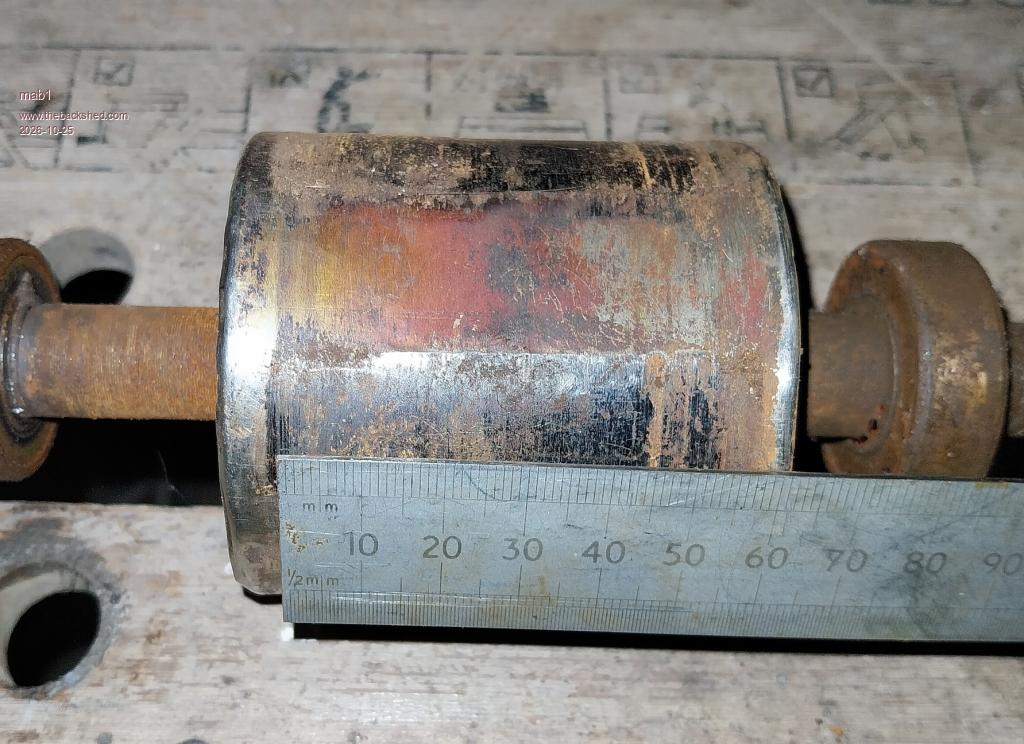
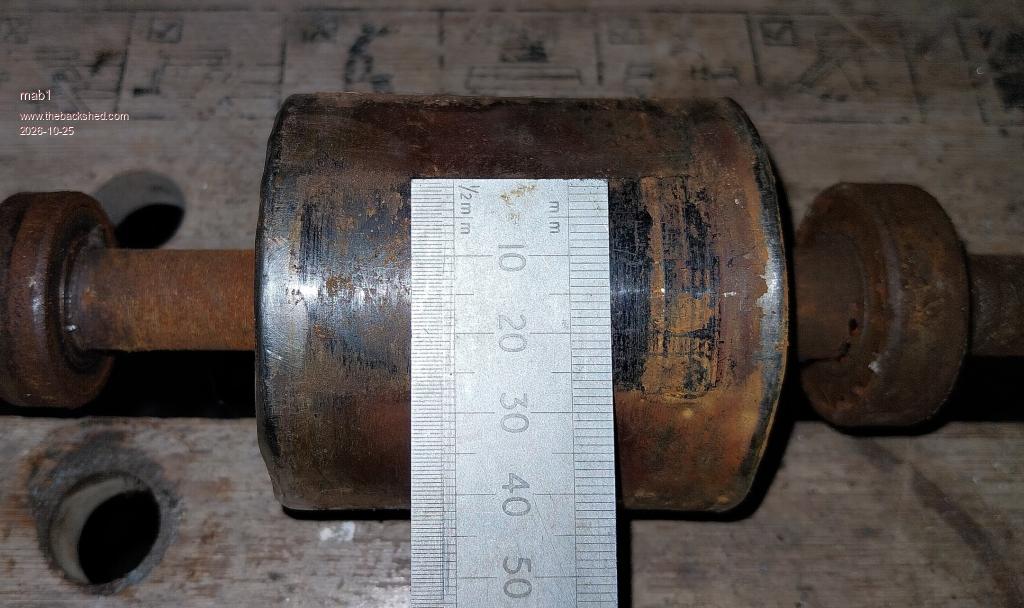
Feels like there are two magnets in each pole: about 25 x 25mm; the ones on the left in the pics are still quite strong, the ones on the right much weaker, but to remagnetize in situ i guess i need a coil approx 25 x 55 mm to cover them both, assuming i can do each pole separately. |
| |
johansen
Newbie
Joined: 01/08/2014
Location: United StatesPosts: 15 |
| Posted: 12:55am 25 Oct 2026 |
Copy link to clipboard |
Print this post |
|
Even if you could concentrate a 3 or more T field into each pole separately, you would have to keep the field less than 1T in the wrong direction in the other poles.
I dont see that as possible without doing all 4 magnets at the same time with an appropriately wound 4 pole coil encased in a steel cylinder as thick as the magnets are wide, so the steel mostly wont saturate. |
| |
mab1
Senior Member
Joined: 10/02/2015
Location: United KingdomPosts: 290 |
| Posted: 10:11am 25 Oct 2026 |
Copy link to clipboard |
Print this post |
|
Thanks Johansen, When you put it like that it does seem like a bit of a tall order TBH.
I might have some microwave tx windings somewhere - if they weren't recycled in a tidy up sometime - but potentially, if i'm really lucky, two primary windings might approximate the 4 bundles of winding needed between the 4 poles. Even if it's not perfect it might give an improvement, and the generator is basically scrap if i can't repair it, anyway.
I was thinking i could use the stator of an old larger diammeter 4 pole induction motor as the outer iron and use its coils to provide the 2T, and squeeze some additional windings between it and the magnet rotor - but that means there's a big air gap between the iron and the magnets. Possibly that's ok as i don't want iron where i'm trying to achieve 3T, but then does the ~2T in the iron contribute anything?
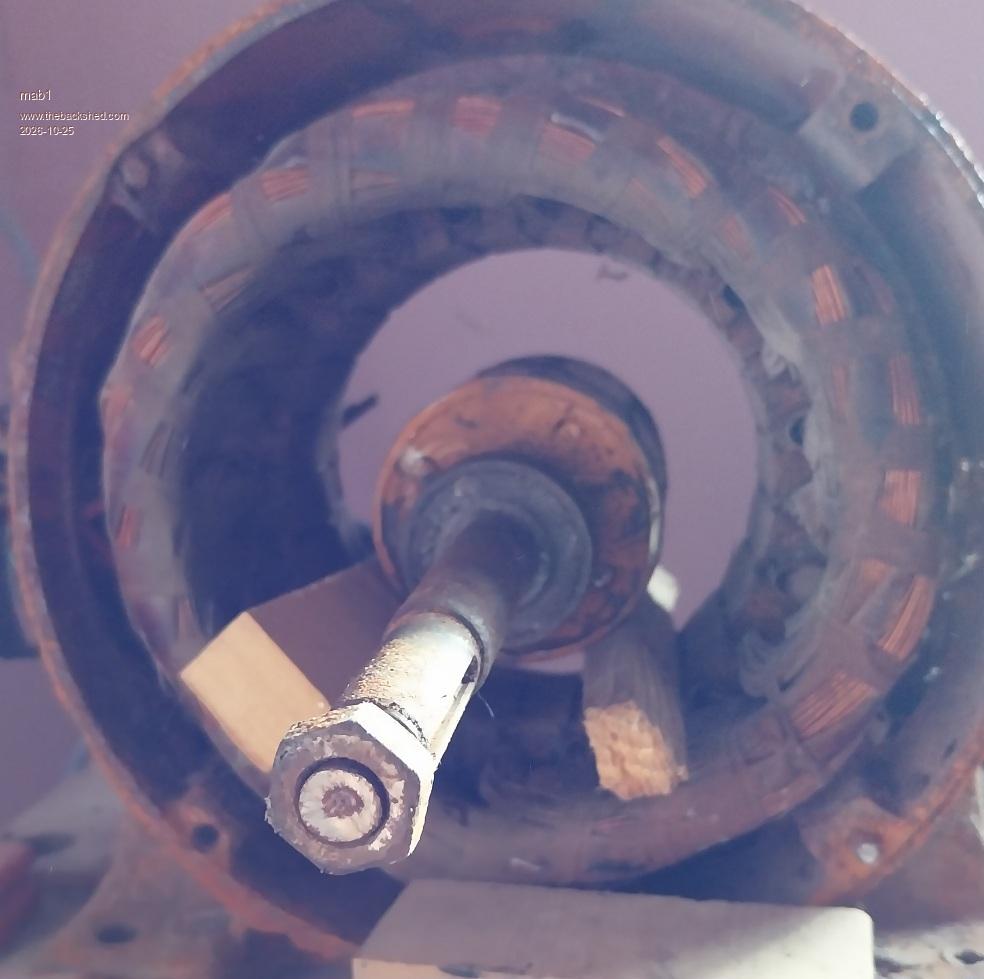
Sort of like this, but with two microwave primaries, one each side of the rotor and concentric, in place of the bits of wood.
Edited 2026-10-25 20:15 by mab1 |
| |

 Notice. New forum software under development. It's going to miss a few functions and look a bit ugly for a while, but I'm working on it full time now as the old forum was too unstable. Couple days, all good. If you notice any issues, please contact me.